
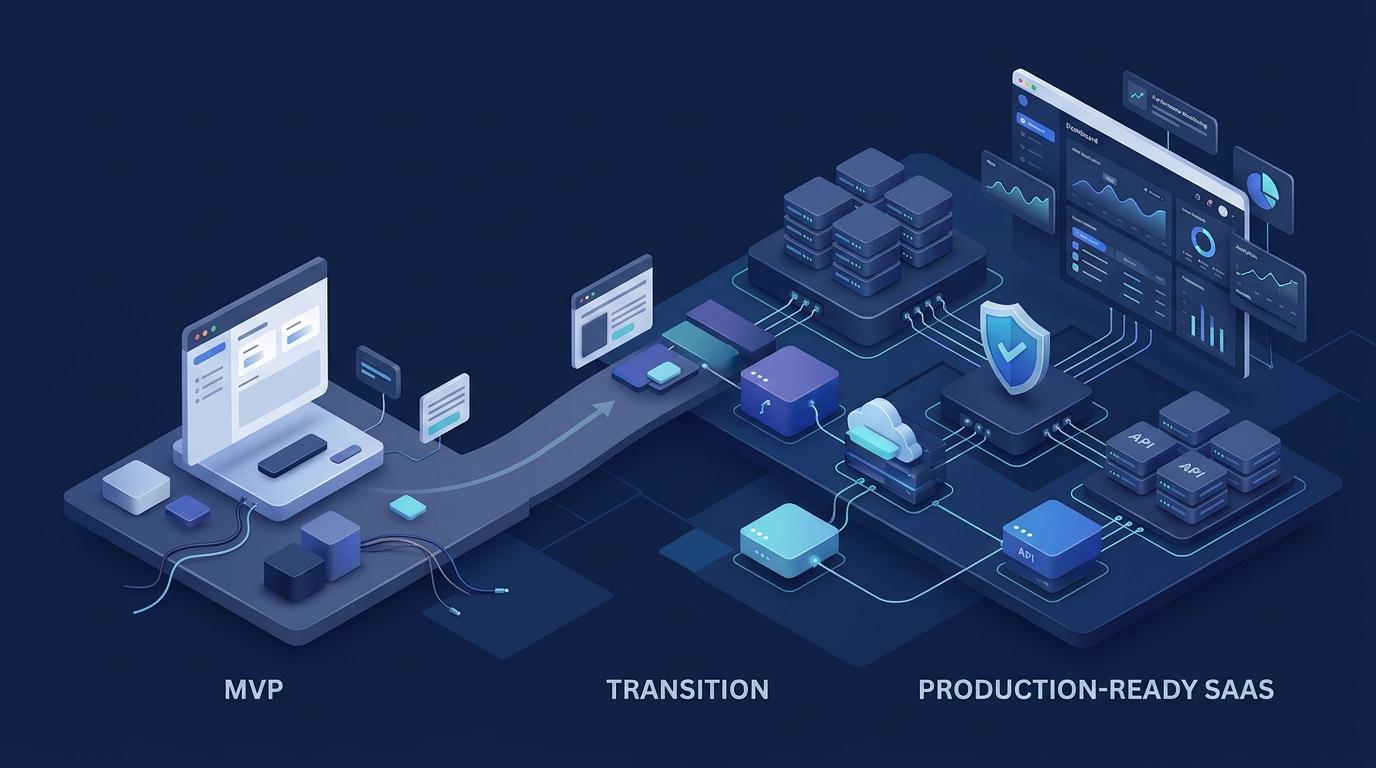
Building an MVP proves that your product can work. Turning it into a production-ready SaaS proves that people can depend on it.
The biggest mistake founders make after launching an MVP is immediately investing in more features. Before adding functionality, you need to make sure the existing application can handle real customers, protect their data, process transactions reliably, and remain maintainable as the business grows.
A successful MVP is a starting point, not the finish line.
Why Your MVP Isn't Ready to Scale
An MVP is designed to validate an idea with the smallest reasonable investment. During early development, teams prioritize essential functionality, collect user feedback, and get the product into people's hands quickly.
That approach makes sense. However, early development decisions can create technical limitations when the product starts gaining traction.
For example, your first version might use basic authentication without granular permissions, database queries that assume a small number of records, or background processes that run inside the main application. These decisions might work with ten users but create reliability problems when hundreds of customers start using the platform simultaneously.
The same problem appears with security, billing, and customer data. A feature that works during a demonstration might not handle duplicate payment notifications, failed background jobs, unauthorized access attempts, or unexpected database failures.
The result is technical debt, performance issues, customer complaints, and expensive emergency fixes.
The goal isn't to rebuild everything. It's to identify which parts of your MVP need improvement and strengthen them before they become business risks.
How to Turn an MVP Into a Production-Ready SaaS
Step 1: Audit Your Existing MVP Before Changing Anything
Before writing new code, understand what you already have.
A common mistake is assuming that an existing MVP needs a complete architectural rewrite. In reality, some parts might be perfectly suitable for production, while others need immediate attention.
Start by reviewing your:
- Frontend and backend architecture.
- Database schema and relationships.
- Authentication and authorization systems.
- API structure and third-party integrations.
- Payment and subscription workflows.
- Application performance and error handling.
- Hosting, deployment, and environment configuration.
Next, identify the application's most important user journeys.
For a subscription-based SaaS, this might include account registration, subscription activation, dashboard access, billing, and cancellation.
For a marketplace, it might involve user registration, creating listings, booking services, processing payments, and managing transactions.
Prioritize problems according to their impact on customers and the business.
For example, a missing password-reset feature is a usability problem, while customers being able to access another company's data is a serious security issue. They should not receive the same priority.
Business impact: An MVP audit helps you spend engineering resources on the problems that genuinely prevent growth instead of paying to replace working functionality.
Step 2: Strengthen Your SaaS Architecture
An MVP can start with a relatively simple architecture. As functionality grows, however, poorly organized code becomes increasingly difficult to maintain.
The solution isn't necessarily microservices or a complicated infrastructure setup. A well-structured monolithic application can support a substantial SaaS product when its responsibilities are properly separated.
Start by organizing your application around clear responsibilities:
- Authentication and user management.
- Business logic and application services.
- Database access and data models.
- Payment and subscription management.
- External API integrations.
- Background processing.
- Notifications and communication.
For example, payment processing should not be tightly coupled to unrelated dashboard functionality. Separating these responsibilities makes future changes easier to implement and test.
If your MVP is built with Next.js, Node.js, and PostgreSQL, you can continue using that stack while improving the codebase, database structure, and API boundaries.
Also, document important API contracts and database relationships. Developers should understand how different components communicate before extending them.
Business impact: A maintainable SaaS architecture reduces the cost of introducing new features, makes debugging easier, and prevents every new requirement from becoming an expensive engineering project.
Step 3: Improve Authentication, Authorization, and Data Security
Security becomes much more important when real customers start trusting your application with personal, business, or financial information.
One common MVP weakness is treating authentication and authorization as the same thing.
Authentication verifies who a user is. Authorization determines what that user is allowed to access or perform.
A production-ready SaaS needs both.
For example, a company administrator might manage subscriptions and invite team members, while an ordinary team member can only access their assigned resources.
Implement the following improvements:
- Secure authentication and password-reset flows.
- Role-based access control (RBAC).
- Server-side permission checks.
- Input validation and API request protection.
- Rate limiting for sensitive endpoints.
- Secure handling of API keys and database credentials.
- Proper session expiration and management.
Multi-tenant data isolation deserves special attention.
In a multi-tenant SaaS, multiple businesses use the same application while maintaining separate data.
A typical database might contain a tenant_id column on records belonging to different customers. Every relevant database operation must enforce the correct tenant boundary.
For example, when a user requests an invoice, the backend should verify that the invoice belongs to that user's authorized organization. It should never rely solely on an invoice ID supplied by the frontend.
Depending on your architecture, database-level controls such as PostgreSQL Row-Level Security (RLS) can provide an additional isolation layer.
AWS specifically highlights tenant isolation as a separate requirement from ordinary authentication and authorization.
Business impact: Strong access controls protect customer information, reduce security risks, and help your SaaS meet the expectations of larger customers as the business grows.
Step 4: Make Your Database Reliable and Maintainable
Your database becomes increasingly important as users, transactions, and application data grow.
An MVP might initially use a simple database structure with limited indexing and basic query patterns. That doesn't mean the database needs to be replaced when the product gains users.
Start by reviewing the existing schema.
Check whether:
- Tables have appropriate primary and foreign keys.
- Important relationships are properly defined.
- Frequently executed queries have suitable indexes.
- Data constraints prevent invalid records.
- Transactions protect operations that must succeed together.
- Database connections are managed efficiently.
Consider a SaaS subscription system. Updating a subscription, recording a payment event, and changing account entitlements are related operations. Your application must handle failures without leaving the account in an inconsistent state.
Database migrations also need a proper process. Avoid making uncontrolled changes directly to the production database.
Use version-controlled migration scripts and test them against a staging environment before deploying them.
Most importantly, implement automated database backups and test your recovery process.
A backup that has never been restored is not a proven recovery strategy. For PostgreSQL applications with stronger recovery requirements, point-in-time recovery (PITR) can help restore a database to a specific moment using archived transaction logs.
Business impact: Reliable database architecture protects business-critical information, reduces downtime, and makes future changes safer.
Step 5: Improve Application Reliability and Background Processing
A production-ready application must handle more than successful requests.
Real applications experience failed API calls, network interruptions, delayed third-party responses, duplicate notifications, and interrupted background jobs.
Your MVP needs a strategy for handling these situations.
Start by identifying operations that should run outside the main request-response cycle.
Common examples include:
- Sending transactional emails.
- Generating reports and documents.
- Processing uploaded files.
- Sending notifications.
- Synchronizing external services.
- Processing payment and subscription events.
Use a background job system or message queue where appropriate.
For example, imagine a customer purchases a subscription. Your application should not depend only on the customer's browser returning to a success page to activate the subscription.
Payment providers can notify your backend through webhooks. These events can be delivered again when previous attempts fail, so your webhook handler must safely handle duplicate events.
Use idempotency: processing the same event more than once should not create multiple subscriptions, duplicate invoices, or repeated business operations.
Also implement sensible retry policies, timeouts, and failure handling. Not every error should trigger unlimited retries.
Business impact: Reliable background processing prevents lost operations, reduces inconsistent customer records, and helps your application remain dependable when external services fail.
Step 6: Introduce Proper Testing and Quality Assurance
A feature working on a developer's computer doesn't prove it will work correctly in production.
As the product grows, one change can unintentionally break another part of the application.
This is why production readiness requires a structured testing strategy.
Start with three important levels:
Unit testing: Test individual functions and business rules independently.
Integration testing: Verify that different components work together, including APIs, databases, authentication, and external services.
End-to-end testing: Simulate complete customer journeys, such as registration, purchasing a subscription, accessing a dashboard, and cancelling an account.
Focus testing efforts on business-critical workflows first.
For example, a billing bug can affect revenue, while an authorization bug can expose customer data. These deserve stronger test coverage than an unimportant visual interaction.
You should also perform load testing before expecting the application to handle significantly higher traffic.
Tools such as k6 can help simulate concurrent users and identify performance bottlenecks.
Business impact: Automated testing reduces production bugs, protects existing functionality, and gives your engineering team confidence when releasing updates.
Step 7: Set Up Monitoring and Production Infrastructure
A production-ready SaaS needs visibility into what happens after deployment.
Without monitoring, you might only discover an issue when customers start reporting it.
Introduce observability through three complementary areas:
Logging: Record important application events, errors, and operational activity. Avoid exposing passwords, access tokens, payment details, or other sensitive information in logs.
Metrics: Track application performance, including response times, request failures, database performance, and background job failures.
Error tracking: Use tools such as Sentry to capture exceptions and understand where problems originate.
Your monitoring system should help answer questions such as:
- Are API requests becoming slower?
- Are users experiencing failed login attempts?
- Are background jobs getting stuck?
- Are database connections reaching their limits?
- Are payment integrations failing?
You should also configure separate development, staging, and production environments.
Keep environment-specific settings outside your application code. Database credentials, API keys, and service endpoints should be managed through environment configuration or a dedicated secrets-management solution.
Finally, establish deployment and rollback procedures.
A failed release should not leave your entire application unavailable while developers manually investigate how to recover.
Business impact: Monitoring and reliable infrastructure help your team detect problems earlier, reduce downtime, and maintain customer trust.
Step 8: Scale Based on Real Performance Data
Once your MVP is secure and reliable, you can start preparing it for higher usage.
However, scaling doesn't automatically mean moving to expensive servers or introducing microservices.
First, identify the actual bottlenecks.
If database queries are slow, review query execution plans and indexes. If expensive operations are repeated unnecessarily, consider caching. If report generation is delaying API responses, move it to background processing.
For applications with increasing traffic, stateless application processes can make horizontal scaling easier because multiple instances can handle requests without depending on local application state.
The Twelve-Factor App methodology describes this approach and recommends separating application configuration from code and treating persistent services as attached resources.
A practical scaling strategy might look like this:
- Optimize database queries and connection management.
- Introduce caching for frequently accessed data where beneficial.
- Move expensive workloads into background jobs.
- Increase application capacity based on measured demand.
- Introduce additional infrastructure only when the existing architecture requires it.
Business impact: Evidence-based scaling keeps infrastructure costs under control while improving performance and supporting sustainable SaaS growth.
A Real Product Example: What Production Readiness Looks Like
Consider EventFlow, a competition management platform featured in Seebify's portfolio.
The platform supports gymnastics and cheerleading competitions, including judge assignments, scoring workflows, scheduling, approval processes, and automated invoicing.
A product like this requires more than a collection of working screens.
Imagine several judges submitting scores while administrators manage schedules and competition divisions. At the same time, organizers need accurate invoices, permissions, and reliable access to competition information.
As usage increases, the engineering priorities become clearer:
- Scoring operations must preserve accurate records.
- Judges and administrators need different permissions.
- Scheduling changes should not create inconsistent competition data.
- Financial operations must prevent duplicate processing.
- Critical workflows need monitoring and reliable error handling.
This demonstrates an important principle: production readiness depends on the actual business workflows your software supports.
An MVP might prove that a competition can be managed digitally. A production-ready platform must make sure the entire operation can be trusted when real organizers, judges, and participants depend on it.
You can explore more products and examples on the Seebify portfolio.
Your MVP-to-Production Readiness Checklist
Before treating your MVP as a mature SaaS product, review the following areas:
MVP-to-production checklist
- •Core user journeys work consistently.
- •Authentication and authorization are properly implemented.
- •Tenant data is isolated where applicable.
- •APIs have appropriate validation and rate limiting.
- •Database relationships and queries are optimized.
- •Database backups and recovery procedures are tested.
- •Payment and webhook workflows handle duplicate events.
- •Background jobs have retry and failure-handling strategies.
- •Critical workflows have automated tests.
- •Application logs, metrics, and error tracking are configured.
- •Development, staging, and production environments are separated.
- •Deployment and rollback procedures are documented.
- •Performance has been tested against expected traffic.
Not every SaaS needs the same infrastructure or level of compliance. A healthcare product, a simple internal tool, and a financial platform have different security, privacy, and operational requirements.
The important thing is to identify the risks associated with your product and address them before they affect customers.
Final Thoughts: Build for the Next Stage, Not Just the Next Feature
Turning an MVP into a production-ready SaaS is an engineering process, not simply a development sprint focused on adding functionality.
You need to strengthen the architecture, secure customer data, improve database reliability, introduce automated testing, monitor application performance, and prepare your infrastructure for growing usage.
But that doesn't mean throwing away your existing MVP.
In many cases, the best approach is to improve what already works, prioritize the most important weaknesses, and introduce stronger engineering practices gradually.
At Seebify, we help startup founders build, improve, and scale production-ready SaaS products with clean architecture and modern engineering practices.
Already Have an MVP That Needs to Become a Reliable SaaS?
Let's review your existing application, identify its technical limitations, and plan the next stage of development.