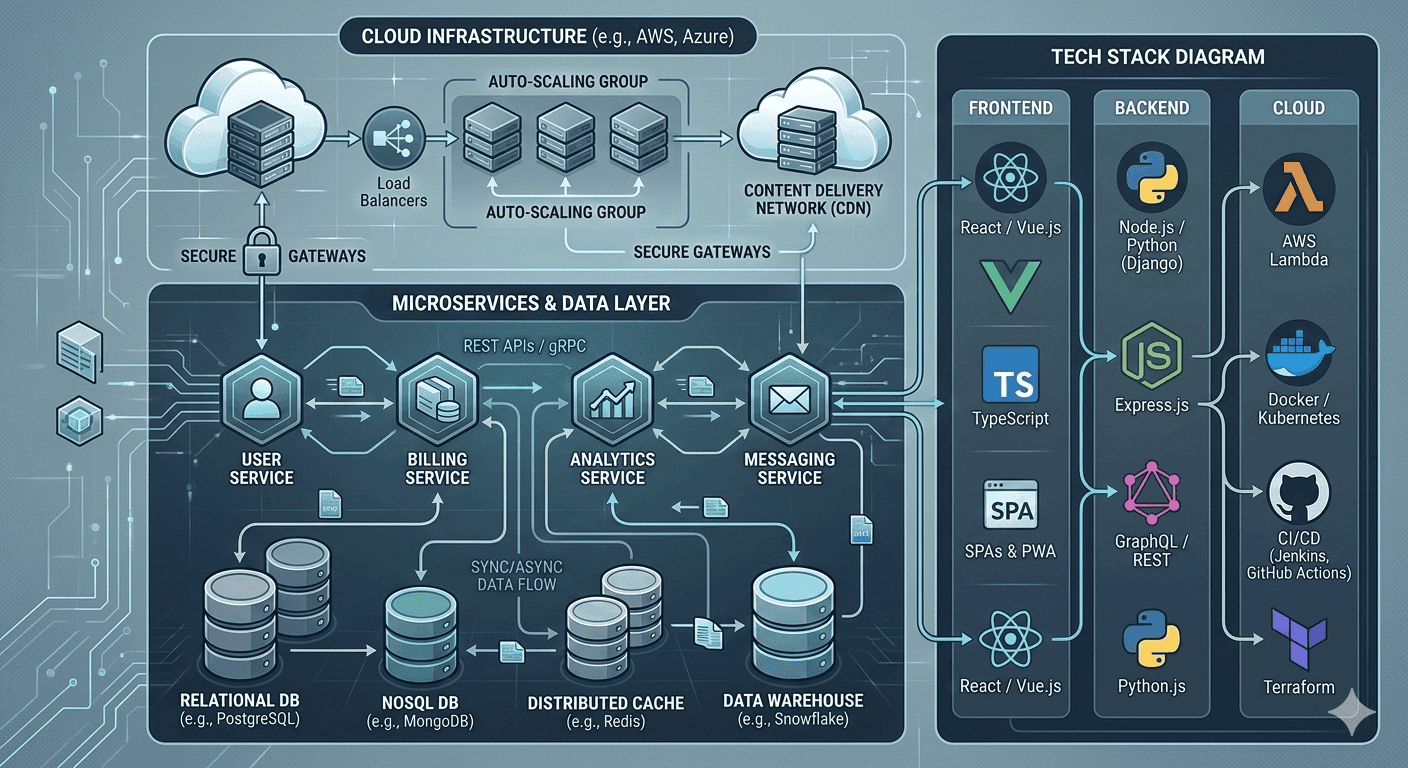
A scalable SaaS architecture doesn’t happen by accident. It’s a deliberate set of decisions that compound over time. Here’s the stack and the principles we use to keep systems fast and maintainable as they grow from 10 to 10,000 users.
The Core Stack: Next.js, Node.js, PostgreSQL
We use Next.js for the frontend and API layer, Node.js for any separate backend services, and PostgreSQL as the primary database. This trio gives us type safety, server-side rendering, and a battle-tested relational store.
| Component | Technology | Why It Scales |
|---|---|---|
| Frontend | Next.js (App Router) | Automatic code splitting, ISR for dashboards |
| Backend API | Node.js + Express | Non-blocking I/O, huge ecosystem |
| Database | PostgreSQL + Prisma | ACID, row-level security, JSONB for flexibility |
| Caching | Redis | Session store, rate limiter, queue processor |
| Async Jobs | pg-boss / BullMQ | Reliable background processing without dropping tasks |
Multi-Tenancy Done Right
We implement shared-table multi-tenancy with Row-Level Security (RLS) in PostgreSQL. Every query is scoped to the user’s tenant, enforced at the database layer—not just in application code. This prevents cross-tenant data leaks by design.
-- Enable RLS on a table
ALTER TABLE tasks ENABLE ROW LEVEL SECURITY;

CREATE POLICY tenant_isolation ON tasks
  FOR ALL
  USING (
    tenant_id = current_setting('app.current_tenant')::uuid
  );
Stateless Application Servers
Every backend service is stateless. Session data lives in Redis; file uploads go directly to S3. This means we can horizontally scale instances behind a load balancer without sticky sessions or shared file systems.
Observability from Day One
We instrument every service with structured logging, distributed tracing, and custom metrics. Tools like OpenTelemetry and Grafana give us visibility into performance bottlenecks before they affect users.
Key Takeaway
Scaling isn’t just about adding more servers. It’s about making architectural decisions that keep complexity under control. With a clean stack, strong isolation, and a culture of observability, you can confidently grow without constant firefighting.
