
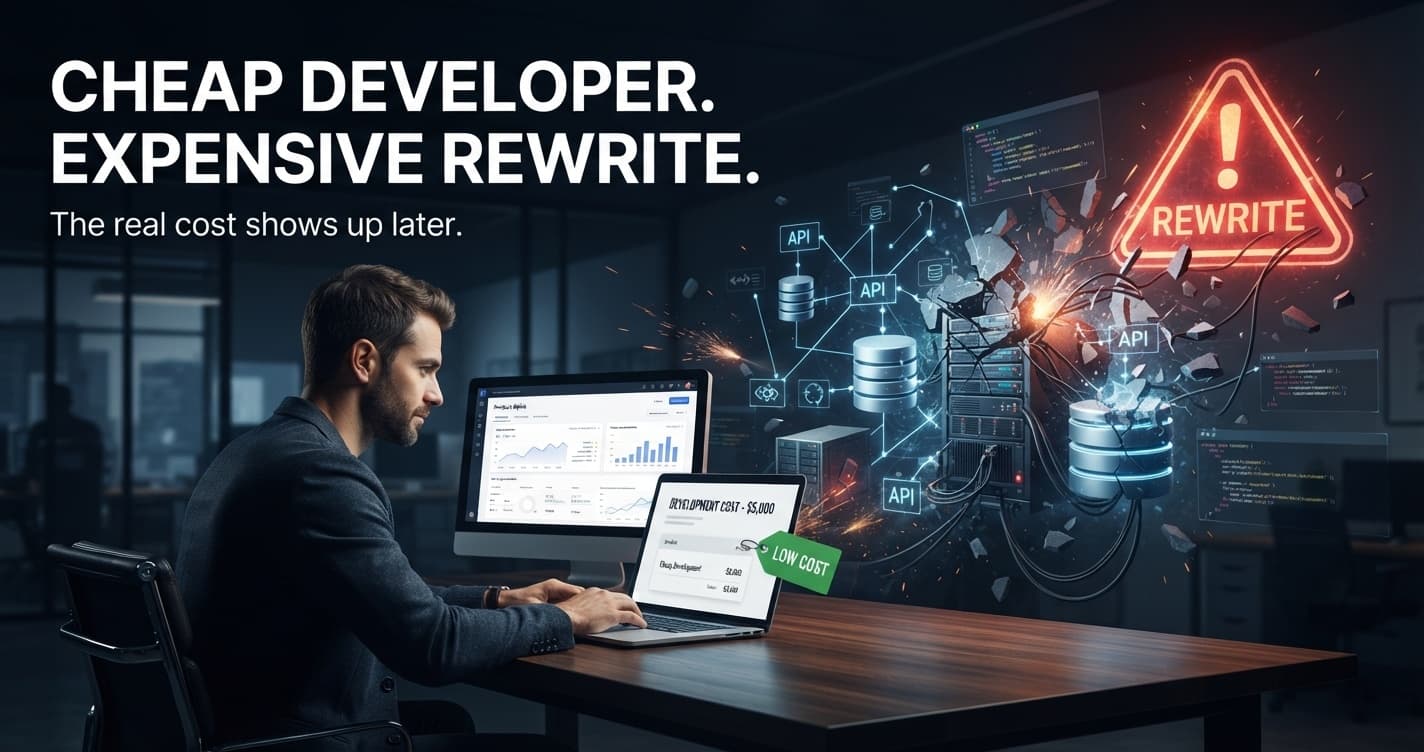
The cheapest developer can be the most expensive person you hire.
Not because inexpensive developers are necessarily bad developers. The problem is choosing a developer only because their hourly rate is low, without understanding how they approach architecture, business requirements, security, scalability, and long-term maintenance.
A SaaS product isn't finished when the first version goes live. It's just beginning. The real cost of a developer often becomes visible six months later — when you need to add a major feature, integrate a payment provider, change a database structure, fix performance problems, or onboard another developer.
That's why founders should look beyond "how much do you charge?" The better question is:
What will this codebase cost me to maintain and change after launch?
Why the Cheapest Developer Can Become Expensive
Imagine two developers quote you for the same SaaS project: Developer A at $2,000, Developer B at $6,000. At first, Developer A looks like the obvious choice.
But what if Developer A builds the application quickly without properly designing the database, authentication, permissions, APIs, deployment process, or business logic? The application launches, you get your first customers, and then you want to add subscriptions, team accounts, role-based permissions, or reporting. Suddenly every feature requires changes in five different places, and the original developer tells you: "we need to rewrite this part first."
Now the $2,000 project wasn't actually $2,000 — you paid $2,000 to build the first version, then paid again to make it maintainable. Before development starts, it's worth understanding what a production-ready SaaS actually requires — read our guide to engineering a production-ready SaaS →
This doesn't mean cheap developers are automatically the risk. A talented developer at a lower rate can be an excellent choice, and an expensive one can still make poor technical decisions. The real risk is choosing primarily on price without evaluating engineering quality and long-term fit — and the rest of this guide is about how to tell the difference.
1. Don't Choose a Developer Based Only on Hourly Rate
Hourly rate is easy to compare. Engineering quality isn't — which is why founders often make the wrong comparison.
It's tempting to assume Developer A gives you the best deal. But hourly rate doesn't tell you how much rework will be required, whether the architecture is maintainable, or whether the system can handle more users. A better comparison is:
Total cost of ownership = initial development + rework + maintenance + scaling + future feature cost
2. Pay Attention to the Questions They Ask You
This is one of the easiest ways to evaluate a developer before hiring them. A developer who immediately says "send me the Figma and I'll give you a price" has learned very little about your product. A strong SaaS developer should understand why the product exists before making important architectural decisions — who your users are, how the business makes money, whether customers have teams or roles, and what happens when a payment fails.
These aren't unnecessary overhead. They're part of engineering. The developer translates business rules into database models, APIs, permissions, and application logic — and if those rules aren't understood correctly at the start, changing them later can require expensive rewrites.
3. Ask: "Have You Shipped a Production SaaS?"
This is more useful than asking how many years of experience someone has. Someone can have five years of programming experience without having owned the engineering problems of a real SaaS product — authentication, failed payments, permissions, backups, monitoring, and changing requirements don't show up in a demo.
Ask: "Can you show me a SaaS product you've shipped that has real users?" Then ask: "Is it still being maintained?" That distinction matters — launching a product is one skill; building something that can keep evolving after launch is another.
4. Look at the Architecture, Not Just the UI
A beautiful dashboard can hide a terrible backend. Suppose your SaaS has a customer dashboard showing subscription information — the UI looks simple, but underneath it involves:
User → Authentication → Authorization → Subscription
     → Payment Provider → Database → Billing Events
     → Webhooks → Account Status
If these relationships aren't designed properly, seemingly simple features can become difficult to change later. A production-ready SaaS needs an architecture that separates important responsibilities — frontend, backend APIs, database, authentication, payments, background jobs, storage, and deployment — rather than putting everything into one giant application layer. The important thing is that the developer should be able to explain why the architecture was chosen.
As the product grows, those early decisions matter even more — learn how to scale a SaaS product →
5. Make Sure They Understand Your Business Logic
This is where many cheap implementations begin to break. A developer might hear "we need recurring payments," integrate Stripe, and create a subscription. But a real SaaS needs to answer: What happens when a payment fails? When does access expire? Can customers change plans? What happens if a payment succeeds but the webhook fails?
These aren't UI questions — they're business rules, and the developer needs to understand them before designing the system.
6. Ask How They Design the Database
Your database is one of the most important parts of a SaaS application, and founders often don't think about it until something goes wrong. A developer should be able to explain the core entities, how they're related, which fields need indexes, and how the database will evolve as the dataset grows. A simple SaaS might start with:
users
organizations
memberships
subscriptions
payments
projects
Good database design — proper relationships, constraints, indexes, and migrations — makes future features easier to build and reduces the likelihood that every new feature requires restructuring the entire application. PostgreSQL is a common choice for SaaS products because its relational model, constraints, indexes, and transaction support work well for applications with interconnected business data.
7. Ask How They Handle Authentication and Permissions
"Login works" isn't the same as "authentication is production-ready." A SaaS application may have several roles — Owner, Admin, Manager, Employee, Customer — each with different permissions. If authorization isn't designed properly, users may access information they shouldn't, which isn't just a technical inconvenience; it can become a security and compliance problem. You don't need to understand every implementation detail — you need to know they've thought about it.
8. Ask What Happens After Launch
A good answer should involve more than "I'll deploy it to Vercel." Production involves ongoing bug fixing, monitoring, backups, database migrations, security updates, and rollback strategy. You should also clarify whether the developer will continue supporting the product — and if not, whether another developer can take over the codebase. Your startup shouldn't become permanently dependent on one person simply because they wrote the original code.
9. Make Sure You Own Your Code and Infrastructure
Before starting development, clarify ownership: who owns the Git repository, the cloud account, the database, the domain, the Stripe account, and the API credentials? Ideally, the founder or company controls the critical accounts. Your developer should be building your product — not becoming the only person who can access it.
10. Don't Let Speed Skip the Decisions That Matter Later
Startups can't spend two years building an MVP, but there are two different kinds of speed. One is fast because everything is skipped — idea, code, launch, problems, rewrite. The other is fast because the important decisions are made early, so the MVP doesn't need to be rebuilt to support the next feature.
That's the balance to look for:
Build only what you need today, but don't build today's product in a way that makes tomorrow's product unnecessarily expensive.
You Don't Need to Be Technical to Evaluate a Developer
You don't need to understand React, PostgreSQL, APIs, or cloud infrastructure to evaluate a developer. Instead, listen to how they explain technical decisions.
- Can they explain why something matters in business terms, not just technical terms?
- Do they identify risks before you point them out?
- Do they ask what happens when requirements change?
- Do they tell you when an idea is unnecessarily complex, rather than just quoting a price for it?
A strong developer shouldn't make you feel technical for the sake of sounding technical. They should make complicated decisions easier for you to understand.
A Practical Checklist for Hiring a SaaS Developer
Business understanding
- •Do they understand what your business actually does?
- •Can they explain your core user journey?
- •Have they identified the most important business rules?
Technical experience
- •Have they shipped production SaaS products?
- •Can they show real products, still maintained?
- •Can they explain their architecture?
Database, security & scalability
- •Can they explain the database design and migration strategy?
- •How will authentication and authorization work?
- •What happens when user numbers increase?
Ownership & maintenance
- •Who owns the Git repository, cloud accounts, database, and payment account?
- •Can another developer take over if needed?
- •Who fixes production bugs after launch?
5 Red Flags When Hiring a SaaS Developer
They give you a price before understanding the product. A rough estimate is normal — a confident final quote without understanding the requirements is different.
They only talk about technologies. If the entire conversation is "I'll use React, Node.js, MongoDB, AWS and Docker" but they never ask about customers, revenue, or business rules, something is missing.
Their portfolio contains only demos. A demo proves someone can build an interface. It doesn't prove they can operate a production system.
They promise everything will be easy. Real SaaS products have complexity. Good developers don't make it disappear — they identify it early and manage it.
They can't explain what happens after launch. If their responsibility ends at "the application is deployed," clarify upfront who handles everything that comes afterward.
A Better Way to Compare Developers
Instead of comparing developers on rate and estimate alone, compare them on what you're actually buying:
The goal isn't to find the developer with the highest rate. It's to understand what you're actually buying.
The 10-Minute Test Before Hiring a Developer
Give the developer your product description and ask:
- What would you want to clarify before starting?
- How would you structure the system?
- What could become difficult to change later?
- What would you build first?
- What happens after launch?
You don't need to be technical to judge the answers. You just need to pay attention to how they think.
Final Takeaway
The right developer isn't necessarily the cheapest — or the most expensive. The right question is:
Can this person build the product I need today without making the product I need tomorrow unnecessarily expensive?
Look at the questions they ask, the production products they've shipped, and how they approach architecture, database design, security, and ownership. Don't evaluate a developer only by what they charge to build version one — evaluate what their decisions could cost you when you're building version two.
Frequently Asked Questions
How do I choose a SaaS developer?
Look for a developer who understands your business requirements, has experience shipping production software, can explain their architectural decisions, considers security and scalability, and can provide clear ownership and maintenance arrangements.
Should I choose a developer based on their hourly rate?
Hourly rate should be one factor, not the primary factor. Compare experience, approach, estimated total cost, communication, architecture, and expected long-term maintenance requirements.
How much does it cost to hire a SaaS developer?
There's no universal price. Cost depends on product complexity, required features, integrations, architecture, security requirements, and whether you're building an MVP or a production-ready SaaS product.
What is the difference between an MVP and a production-ready SaaS?
An MVP focuses on validating the core product idea with the minimum useful functionality. A production-ready SaaS also needs reliable authentication, authorization, database architecture, security, error handling, deployment, monitoring, and infrastructure appropriate for real users.
How can I tell if a developer has real SaaS experience?
Ask for examples of products they've shipped and whether those products have real users and are still being maintained. Then ask what they were responsible for and what technical problems they solved.
Can a cheap developer build a good SaaS?
Yes. Price alone doesn't determine engineering quality. The important question is whether the developer has the skills, experience, communication, and engineering process required for your product.
Building or Scaling a Production-Ready SaaS?
If you already have an idea, prototype, MVP, or existing SaaS product and need help deciding what to build next, Seebify can help you evaluate the technical requirements and choose a practical engineering path.
We help startup founders build, launch, and scale production-ready SaaS products with clean architecture and modern engineering practices. You can also explore our SaaS development services or see examples of products we've built.
Ready to discuss your product?