
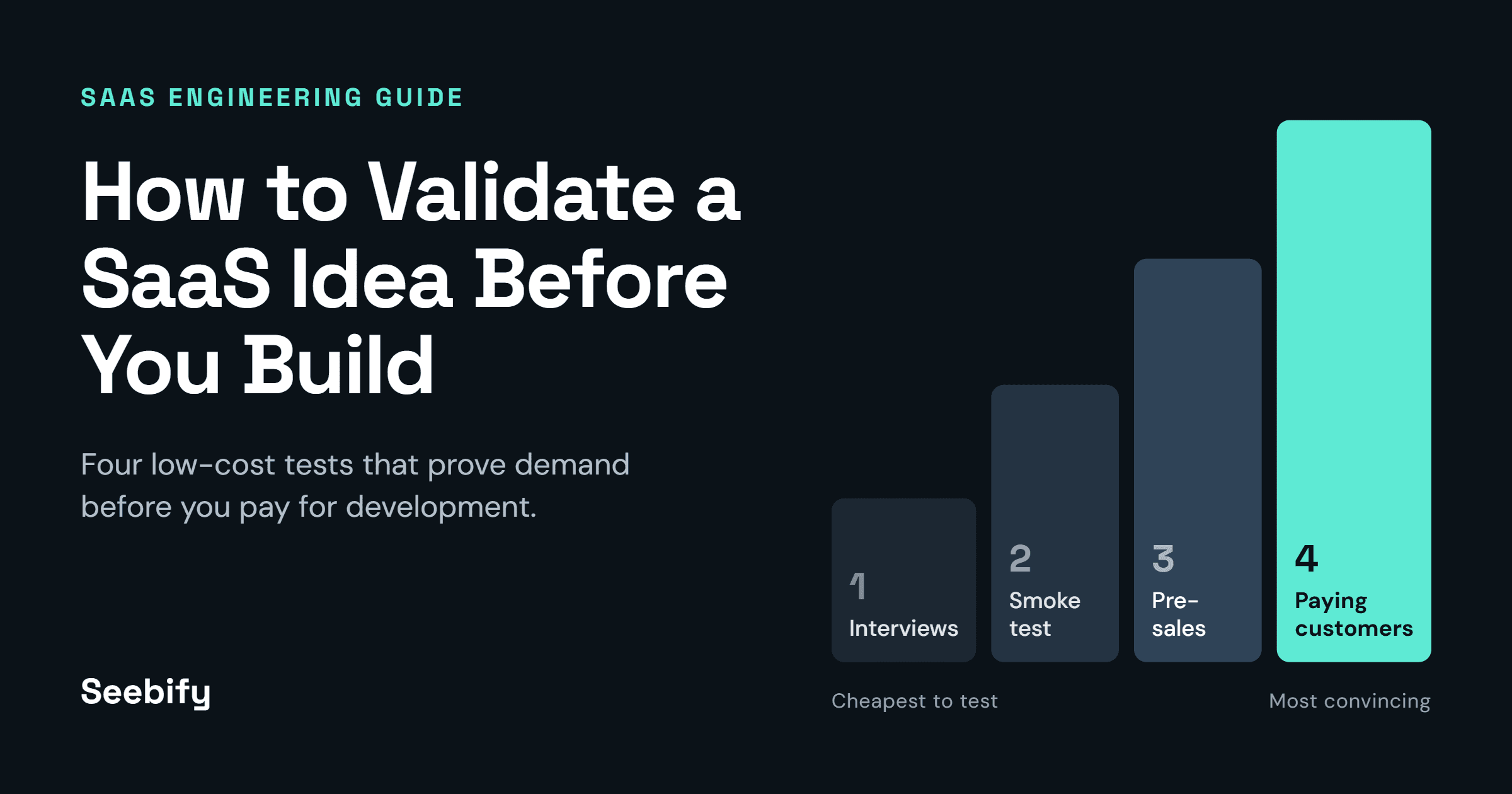
The most expensive line of code in a SaaS startup is usually the first one, because it gets written before anyone has agreed to pay for the product. Knowing how to validate a SaaS idea turns that guess into evidence: a few weeks and a small budget now, instead of a $3,000–$7,000 build (the range of our own Product Launch Engineering service, over 4–6 weeks) that nobody wants.
Why Founders Build Before They Validate
The founders who hit this wall are rarely careless. They have a real problem in mind, a few encouraging conversations and a developer ready to quote. Building feels like progress, and validation feels like delay.
The trouble is that encouragement is not evidence. Friends and colleagues say "good idea" because it costs them nothing. Real validation separates interest (someone says it sounds useful) from intent (someone gives you their time, their data or their money).
AI tools have made building faster, which makes this worse: when almost anything can be built in a few weeks, the scarce thing is proof that someone wants it. The steps below run from cheapest to most convincing, so you can stop spending the moment the evidence says no. If you want the full numbers on what a build costs, see How Much Does It Cost to Build a SaaS in 2026?
How to Validate a SaaS Idea, Step by Step
Each step below states what you do, then what it means for your budget and your decision.
Step 1: Write the problem in one sentence
Name who has the problem, what it costs them and how they cope today, without mentioning your product. For example: "Freelance bookkeepers lose hours every month chasing clients for missing receipts by email."
If you can't write this sentence, the idea isn't testable yet, and any developer you hire will fill the gaps with guesses. That is how scope grows.
Step 2: Interview about past behaviour, not opinions
Talk to about 10 people who have the problem. Ask what they did the last time it happened, what it cost them and what they tried. Don't pitch.
What people did is evidence; what they say they might buy is not. Ten conversations is usually enough to see a pattern, and if you are still booking calls after 30, you are probably delaying the build rather than learning more.
Step 3: Check that people already pay for a workaround
Search for the competitors and workarounds your interviewees use. Read their pricing and their negative reviews.
Existing spend is proof of demand, so a crowded market is a better sign than an empty one. Your opening is whatever the one-star reviews keep repeating.
Step 4: Run a smoke test
Build a one-page site with a single promise and one button. A static page on Vercel or any page builder is enough, and you track clicks on that button as an event in your analytics.
This measures behaviour instead of opinion and costs a day instead of weeks of development. It only means something if you send targeted traffic to it: communities, direct messages or a small ad test where your buyers actually are. Write down the result that would make you build before you look at the numbers, so you can't talk yourself into a pass. If budget is your main constraint, How to Build a SaaS MVP With a Small or Zero Budget covers the cheapest ways to go further.
Step 5: Ask for money before the product exists
Add a Stripe Payment Link for a refundable founding-member deposit or a pre-order, and say plainly that the product isn't built yet.
A payment is the strongest signal you can get without writing code, and it costs one link to test. The trade-off is that you owe those customers clear communication, and a refund if you decide not to build.
Step 6: Deliver the first results by hand
Serve your first few customers manually with spreadsheets, forms and email, telling them honestly that the process is early.
You learn which steps customers actually value before you pay to automate any of them. The first part that breaks under real use tells you what your MVP should contain.
Step 7: Prototype only what needs testing
If your biggest risk is usability rather than demand, make a clickable prototype in a design tool and watch people use it.
A prototype shows whether people can use the product, not whether they will pay for it, so run it alongside steps 1 to 6, never instead of them. For the difference between a prototype, a proof of concept and an MVP, read MVP vs Prototype vs Proof of Concept: What Should You Build First?
Step 8: Decide with go/no-go criteria
Fix your criteria before you start, then score the evidence against them.
One bar founders use before building is three paying customers, at least one of them not a friend, still active in a second month. Adjust it to your market, but set it first.
A failed test usually points to the wrong problem or the wrong audience before it points to missing features, so change those before you change the product.
When to Start Building
Once the criteria are met, build the smallest version that does what your paying customers asked for. We offer two ways to keep that first build small: a Feature Sprint (1–3 weeks, $500–$2,000) puts your riskiest capability into production, and Product Launch Engineering (4–6 weeks, $3,000–$7,000) delivers the full first version.
Either way, you pay to build only what customers have already proved. If you are comparing partners, How to Choose a SaaS Development Company in 2026 lists what to check.
Frequently Asked Questions
How many people should I talk to before building?
About 10 is enough to see a pattern. Past 30, you are more likely delaying than learning.
Can I validate a SaaS idea without building an MVP?
Yes. Interviews, a smoke test, pre-sales and manual delivery all work without product code, which is why they come before any build.
How do I find people to interview?
Start where your buyers already gather: niche Slack and Reddit groups, LinkedIn outreach and referrals from your first few interviews. Contribute something useful before you ask for their time.
How long does validation take?
Steps 1 to 5 can fit in a few weeks if you can reach buyers quickly. Slow access to buyers is what usually stretches the timeline.
Real Example From Our Work
Some products carry rules that are expensive to get wrong in code. NutriFlow, a subscription platform we built for meal-prep and wellness businesses, handles recurring billing, configurable delivery cutoff times and delivery fees calculated from location data. You can see it and our other products on the work page.
That kind of complexity is exactly what you test by hand first. Before automating cutoff-time logic, a founder can run a few weeks of orders through a form and a spreadsheet and see which rules customers actually trip over. What breaks in that manual run becomes the first thing worth building, and what never comes up can wait.
Not Sure Your Idea Is Ready to Build?
If you're deciding whether your idea is ready to build, or what the smallest first version should be, we're happy to talk it through.