
Choosing a SaaS development company in 2026 is not simply about finding developers who can build your screens.
You are choosing the team that will make decisions about your product architecture, database, authentication, payments, integrations, security, deployment, and future scalability.
And that creates a problem for founders.
Almost every development company promises experienced developers, modern technology, fast delivery, and competitive pricing. But those promises don't tell you whether the team can actually build a SaaS product that survives real users, real payments, and constant changes after launch.
The right question is not:
"Which company can build my SaaS?"
It is:
"Which development partner can build the right first version without creating problems I'll have to pay to fix later?"
Here is how to evaluate that. If you're still deciding between hiring an individual and an agency, our guide on how to choose a SaaS developer covers the individual-hire side of the same decision.
1. Start With the Product, Not the Development Company
Before comparing companies, get clear about what you actually need to build.
You don't need a 30-page specification, but you should know:
- Who is the target user?
- What problem does the product solve?
- What is the primary workflow?
- What must be included in version one?
- What can wait until later?
- Will you charge users from day one?
- Do you need multiple roles or organizations?
- Do you need third-party integrations?
- What deadline matters to the business?
This matters because a good SaaS development company should help you make trade-offs.
Suppose you have an idea with 25 possible features.
A weak development partner may simply turn those 25 features into a quote.
A stronger product-engineering team may say:
"These seven features are enough to validate the business. The other 18 can come after you have real users."
That difference can save months of development and a large amount of money.
At Seebify, we follow this principle across our product work: keep the first version focused while making the underlying engineering reliable enough to support real users. Our production-ready SaaS approach starts with discovery, architecture, core workflows, and production requirements rather than simply turning a feature list into code.
2. Look for Real SaaS Experience, Not Just Software Experience
A company may have built dozens of websites and applications without having much experience building SaaS.
Those are different things.
A typical SaaS product can involve:
- User authentication
- Organizations and teams
- Roles and permissions
- Subscription billing
- Recurring payments
- Admin dashboards
- Transactional workflows
- Notifications
- APIs and integrations
- Multi-tenant data
- Background jobs
- Analytics
- Monitoring and error tracking
Ask a potential development company:
"Show me SaaS products you have actually shipped."
Not screenshots.
Not Figma designs.
Not concepts.
Ask for live products, case studies, or concrete examples of systems they have delivered.
Then ask what they personally worked on.
For example:
- Who designed the database?
- Who built the backend?
- Who handled deployment?
- Who integrated billing?
- How did they handle permissions?
- What happened when the product started getting more traffic?
- Who maintains it after launch?
You are looking for evidence that they understand the problems that happen after the first deployment.
3. Don't Choose a Company Just Because They Use Your Preferred Stack
Founders often start with:
"Should I hire a company that uses Next.js?"
or:
"Do they work with React, Node.js and PostgreSQL?"
The technology matters, but it should not be the first filter.
A good development partner should be able to explain why a particular architecture makes sense for your product.
For example, a modern SaaS might use:
Frontend:       Next.js
Backend:        Node.js
Database:       PostgreSQL
Payments:       Stripe
Infrastructure: Vercel, AWS, or another suitable provider
That can be an excellent stack.
But the same stack may be completely wrong for another product.
The important question is not:
"Do you use the latest technology?"
It is:
"Can you explain the engineering trade-offs for my product?"
A good team should be able to explain architecture in business terms.
For example:
Mechanism: Use PostgreSQL to keep transactional business data in a structured relational database.
Business consequence: Your team gets stronger consistency and more predictable relationships between users, subscriptions, orders, permissions, and other core records.
That is the level of conversation you want from a SaaS development partner.
Seebify's own architecture work commonly uses Next.js, Node.js, PostgreSQL, Redis, and background-job systems, but the underlying principle is more important than the individual technologies: architecture should control complexity as the product grows. We cover this in more detail in SaaS Architecture That Scales.
4. Ask How They Design for Scale
You don't need to build for 10 million users on day one.
But you also don't want an architecture that becomes impossible to change after your first 1,000 users.
Ask questions such as:
"How will you structure the database?"
"How will you separate customer data?"
"How will background jobs work?"
"What happens when a database query becomes slow?"
"How would you scale the application if usage increases?"
A team with SaaS experience should be able to discuss concepts such as multi-tenancy, indexing, caching, queues, database optimization, horizontal scaling, and observability without turning the conversation into meaningless technical jargon.
The goal is not to over-engineer your MVP.
The goal is to make sensible decisions now that leave you room to grow later.
This is a distinction Seebify emphasizes in its architecture work: scaling is not simply adding more servers; it starts with understanding the bottleneck and making architectural decisions that keep complexity under control. For a deeper look, read our practical guide to scaling a SaaS product.
5. Treat Security as Part of Development, Not a Final Step
Security shouldn't appear in the project plan as:
"Security — Week 6."
It should be considered throughout development.
Ask how the company handles:
- Authentication
- Authorization and role-based access
- Password and session security
- API protection
- Rate limiting
- Input validation
- Database access
- Secrets and environment variables
- File uploads
- Backups
- Error logging
- Production access
You don't necessarily need an enterprise security program for an early-stage SaaS.
But the team should know what the important risks are and how they will be addressed.
OWASP's Application Security Verification Standard provides a framework for testing technical security controls in web applications, covering areas such as architecture, authentication, and secure development. It is a useful reference point when discussing how a development partner approaches application security.
Payments deserve extra attention.
If your product accepts cards, ask how payment data flows through the system. For example, Stripe documents that Checkout and Elements can keep card data from touching your servers and can reduce the scope of your PCI obligations compared with integrations that send raw card data directly to Stripe's API.
You don't need to become a security expert.
You need a development partner who takes security seriously before something goes wrong.
6. Understand Their Development Process
Ask what happens between signing the agreement and receiving the finished product.
A mature process usually has clear stages.
For example:
Discovery → Architecture → Design → Development → Testing → Staging → Production
Ask:
- What happens in the first two weeks?
- Who makes architecture decisions?
- When do I see working software?
- How are changes handled?
- How often do you deploy to staging?
- How do you test critical workflows?
- Who approves releases?
- How do you handle bugs?
- What happens if the deadline starts slipping?
Be careful when a company starts coding immediately without first understanding the product.
Fast coding is not the same thing as fast product delivery.
Ten days spent clarifying architecture can prevent months of rebuilding.
7. Ask Who Will Actually Build Your Product
During the sales process, you may speak with a founder, salesperson, project manager, or solutions consultant.
That's fine.
But you should also understand who will actually write the code.
Ask:
"Who will be my main engineer?"
"How senior are they?"
"Will the same people stay on the project?"
"Do I get direct access to the engineering team?"
This matters because communication quality can dramatically affect a SaaS project.
You should be able to ask:
"Why did you design this database relationship this way?"
and get a clear answer.
Not:
"That's just how our developers usually do it."
You want a partner who can explain technical decisions in language you can understand.
That is especially important for non-technical founders.
8. Clarify Code Ownership Before Development Starts
This conversation should happen before you sign.
Ask:
- Who owns the source code?
- Who owns the database schema?
- Who owns the designs?
- Who owns the documentation?
- Who controls the cloud accounts?
- Who controls the domain?
- Who controls third-party services?
- Can another developer take over later?
- Will I receive the complete repository?
- Are there restrictions on using the code elsewhere?
Ideally, your company should control the important product assets.
At Seebify, code ownership is part of the positioning of our product-engineering service because founders should not discover six months later that they cannot independently access or maintain the software they paid to build.
9. Compare Pricing Based on Scope, Not Just the Lowest Number
One of the easiest mistakes founders make is comparing proposals like this:
Company A: $8,000
Company B: $15,000
Company C: $25,000
Then choosing the cheapest.
That doesn't tell you anything.
Instead, compare what each proposal includes.
For example:
Now you are comparing the same project rather than three different numbers.
Also ask what happens when the scope changes.
A good proposal should explain:
- What is included
- What is excluded
- What counts as a change request
- How additional work is priced
- What happens when requirements change
- What support is included after launch
Seebify's own 2026 cost guide makes the same broader point: SaaS cost depends heavily on scope, complexity, integrations, design requirements, team structure, and the quality bar required for launch — not simply on the fact that something is "SaaS."
10. Ask What Happens After Launch
This is one of the most important questions.
Your SaaS is not finished when version one goes live.
After launch, you will probably need:
- Bug fixes
- Performance improvements
- New features
- Product experiments
- Security updates
- Infrastructure changes
- Database optimization
- Third-party integrations
- Analytics
- AI or automation features
Ask the company:
"What happens after launch?"
Do they offer a maintenance plan?
Can the same engineers continue working with you?
Can they help with scaling?
Can they take over an existing codebase?
Can they work in short feature sprints instead of forcing you into another large project?
A long-term relationship can be more valuable than simply finding someone who can deliver version one.
A Real Example: Why SaaS Complexity Is Hidden Behind the UI
Consider two products.
On the surface, both could look like ordinary web applications with dashboards, forms, and user accounts.
But the engineering requirements can be completely different.
For example, EventFlow at Seebify involves competition management, multi-level scoring, judge assignments, approval workflows, scheduling, and automated invoicing. NutriFlow involves subscriptions, recurring billing, delivery scheduling, cutoff times, and dynamic delivery fees. You can see more in our product work.
Neither product can be evaluated properly by counting screens.
The difficult part is the business logic behind those screens.
That's why a SaaS development company should understand workflows, data relationships, permissions, billing, integrations, and edge cases — not just frontend development.
11. Ask These Questions Before Hiring a SaaS Development Company
Before making a decision, ask every shortlisted company the same questions.
Experience
- •How many SaaS products have you actually shipped?
- •Can I see live products or case studies?
- •Can I speak with a previous client?
Architecture
- •How would you structure my database?
- •How would you handle users, roles, and organizations?
- •What parts of the system need to be designed for scale from day one?
Security
- •How will authentication and authorization work?
- •How will you protect sensitive data and APIs?
- •How will payment data be handled?
Delivery
- •What will you deliver in the first two weeks?
- •How often will I see working software?
- •How do you handle changes in scope?
Ownership
- •Do I receive the complete source code?
- •Who owns the infrastructure accounts and intellectual property?
After launch
- •What happens when we need changes six months later?
The quality of the answers will tell you much more than a polished sales presentation.
A Simple Way to Shortlist Development Companies
You don't need a complicated scoring system.
Start with a few basic gates.
Shortlist gates
- •Pass: They have shipped SaaS products.
- •Pass: They can explain architecture clearly.
- •Pass: They can explain how they handle security.
- •Pass: The proposal clearly defines scope.
- •Pass: You retain control of your code and infrastructure.
- •Pass: They explain what happens after launch.
Then compare the companies that pass those checks based on your budget, timeline, communication style, product complexity, and the level of involvement you need.
This makes the decision much more objective.
Final Takeaway
Choosing a SaaS development company in 2026 is less about finding the company with the biggest team or the longest technology list.
It is about finding a partner that understands the full lifecycle of a SaaS product.
From:
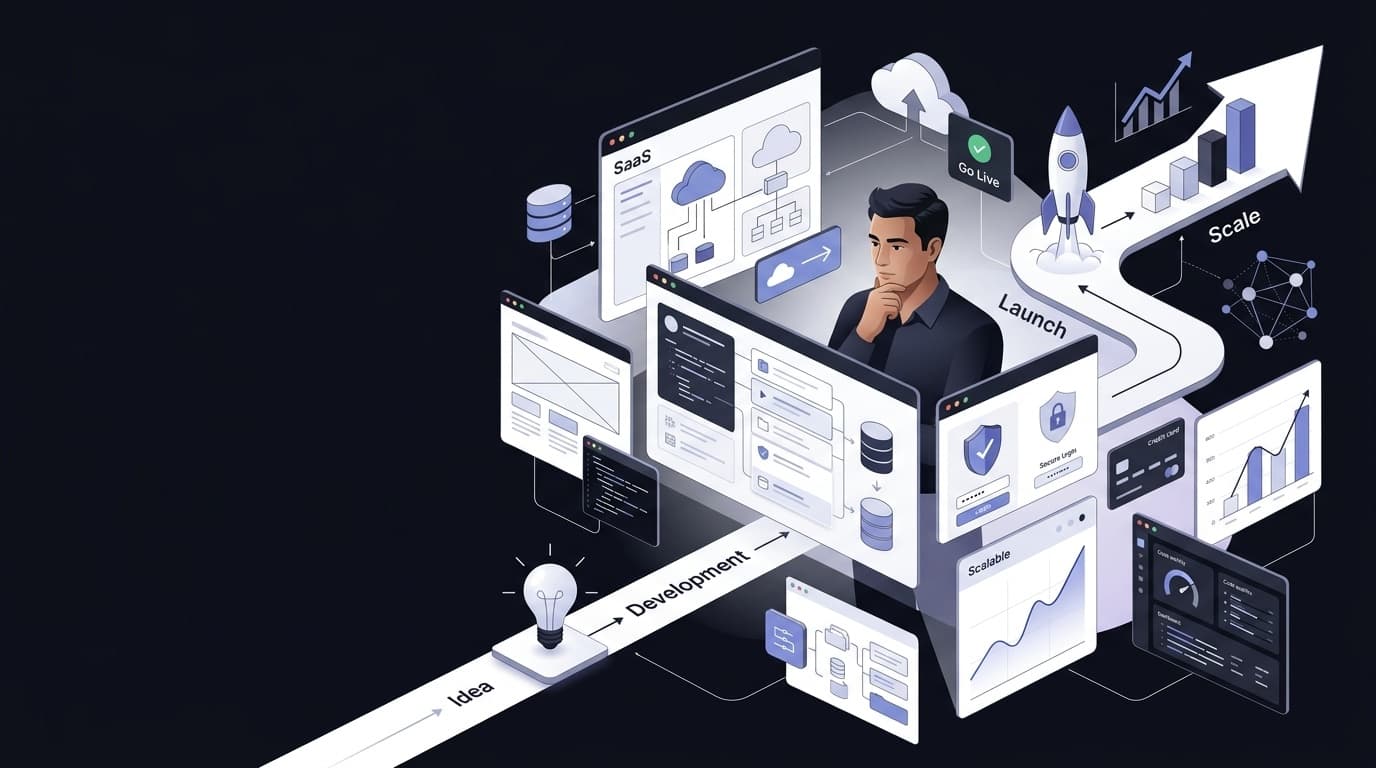
Idea → Discovery → Architecture → Development → Launch → Users → Scaling
The strongest signs are usually simple:
- They have real SaaS experience.
- They can explain technical decisions clearly.
- They understand security and production readiness.
- They are transparent about scope and pricing.
- They give you ownership of your product.
- They have a realistic plan for what happens after launch.
Don't choose a company because it promises to build everything.
Choose a team that can help you decide what actually needs to be built — and build that foundation properly.
Building a SaaS Product?
At Seebify, we help startup founders build, launch, and scale production-ready SaaS products with modern engineering and clean architecture.
Whether you're starting from an idea, replacing an early MVP, or dealing with an existing product that needs to scale, the first step is understanding what your product actually needs. You can also explore our SaaS development services.
Ready to discuss your product?