
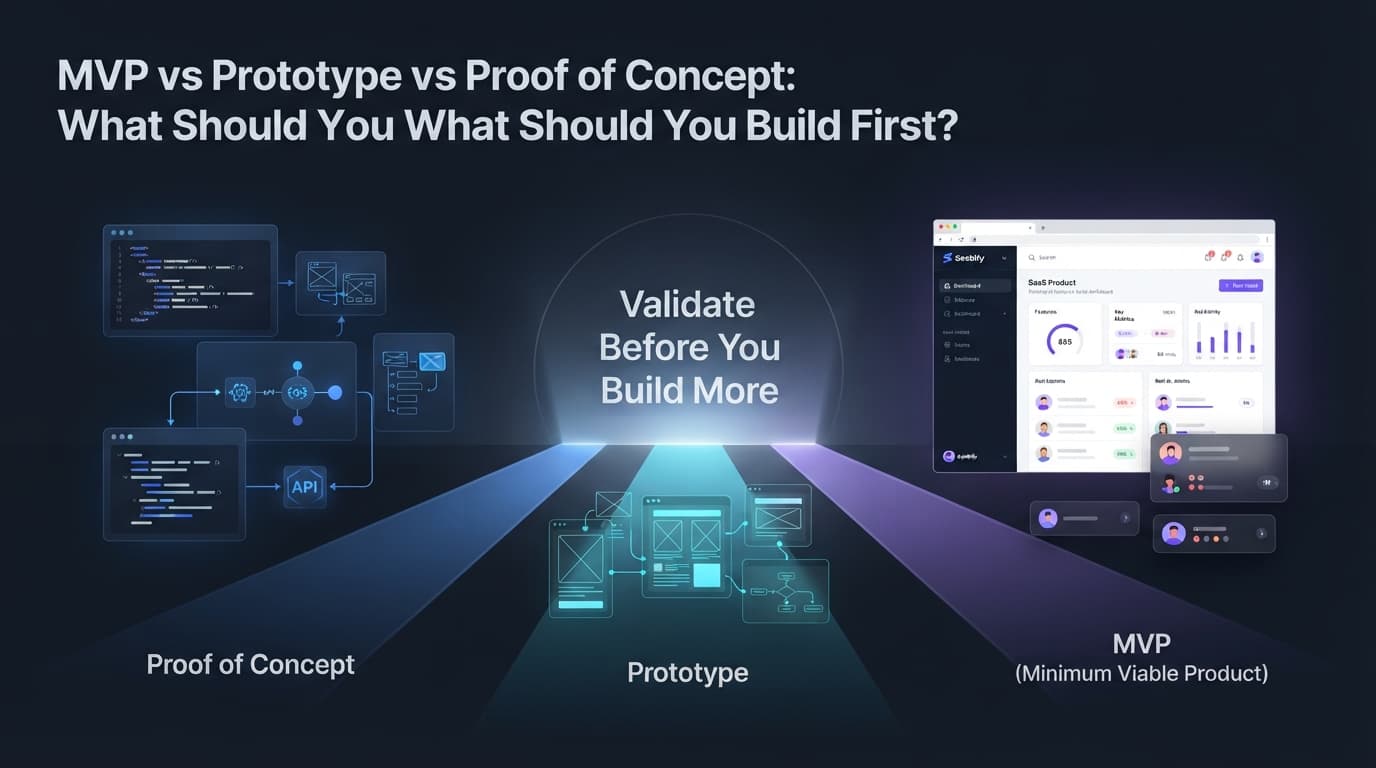
One of the most expensive mistakes founders make is building an MVP before they know what they actually need to validate.
Sometimes the right first step is a prototype. Sometimes it is a proof of concept. And sometimes building either one is a waste of time — you should go straight to an MVP.
The right choice depends on the biggest uncertainty in your product:
Do you need to validate the technology, the user experience, or the actual business?
The Problem: Founders Often Build Too Much, Too Early
When someone has a new SaaS or startup idea, the usual advice is simple: "Build an MVP."
But an MVP isn't automatically the smallest or cheapest thing you can build.
If you're unsure whether users will understand your product, spending weeks building authentication, databases, APIs, dashboards, payments, and deployment infrastructure won't answer that question.
Likewise, if your product depends on a technically difficult integration or an AI workflow that you're not sure is possible, building a polished MVP before testing the core technology can be an expensive mistake.
That's why it helps to understand the difference between a proof of concept (PoC), prototype, and minimum viable product (MVP). They solve different problems.
MVP vs Prototype vs Proof of Concept
Before discussing when to use each one, here's the simplest way to think about them:
The important point is that these aren't simply three levels of the same product. A PoC, prototype, and MVP have different jobs.
1. What Is a Proof of Concept (PoC)?
A Proof of Concept answers one primary question:
Is this technically possible?
A PoC is useful when your product depends on something uncertain from a technical perspective.
For example, imagine you're building a SaaS product that needs to:
- Extract structured information from uploaded documents
- Generate personalized recommendations using AI
- Synchronize data with a third-party system
- Process large datasets in real time
- Connect to an API with unusual requirements
- Generate accurate results from complex business rules
Before building the entire product, you may want to test the riskiest technical component.
How it works technically
Instead of building the entire application, the developer creates a small experiment around the uncertain technical requirement. For example:
PDF Upload
     ↓
Document Processing
     ↓
AI Extraction
     ↓
Structured JSON
You might build only this workflow. There may be no polished dashboard, authentication, billing system, or production database.
The business consequence
You spend a small amount of time answering a potentially expensive question before committing to the full product. If the experiment fails, you have learned something valuable without spending the budget required for the entire MVP.
When should you build a PoC?
A PoC makes sense when
- •The core technology is uncertain
- •A third-party API is critical to the product
- •AI/ML accuracy is a major risk
- •Performance requirements are unusual
- •A technical integration could block the product
- •You don't know whether a critical workflow is feasible
When you don't need a PoC
Don't build a PoC simply because someone told you every startup needs one. If you're building a relatively conventional SaaS using technologies such as Next.js, Node.js, PostgreSQL, Stripe, and established APIs, there may be little technical uncertainty. In that situation, a PoC can become unnecessary work.
2. What Is a Prototype?
A prototype answers a different question:
Will users understand and interact with the product the way we expect?
A prototype focuses primarily on the experience, not the complete underlying system. It can range from simple wireframes to a highly interactive design that looks almost like a real application.
For example, suppose you're building a SaaS dashboard for restaurant owners. You might prototype:
Login
  ↓
Dashboard
  ↓
Sales Overview
  ↓
Inventory
  ↓
Low Stock Alert
  ↓
Reorder Product
The screens can be clickable even if there is no real database behind them.
How it works technically
A prototype may be created in a design tool or as a lightweight frontend application. Data can be mocked:
const products = [
  {
    name: "Coffee Beans",
    stock: 12,
    status: "Low Stock"
  },
  {
    name: "Milk",
    stock: 45,
    status: "In Stock"
  }
];
The interface behaves like the real product, but the data isn't necessarily connected to a production backend.
The business consequence
You can put the experience in front of potential users before paying to build the entire system. This helps uncover problems such as:
- Users don't understand the dashboard
- The workflow has too many steps
- Important information is difficult to find
- The product solves a different problem than expected
- Users want a different workflow entirely
Fixing these problems in a prototype is dramatically cheaper than discovering them after the MVP has been built.
3. What Is an MVP?
An MVP (Minimum Viable Product) answers the most important business question:
Will real users actually use this product to solve a real problem?
An MVP is not just a prototype with more features. A proper MVP is a real, usable product with enough functionality to deliver its core value. That usually means some real engineering is required.
For a SaaS product, an MVP may include:
- Authentication
- User accounts
- Database
- Core business workflow
- APIs
- Basic admin functionality
- Payments, if necessary
- Error handling
- Production deployment
- Analytics
- Basic security
It does not mean building every feature you eventually want.
How it works technically
Suppose you're building an appointment-management SaaS. The MVP might support:
User Signup
    ↓
Create Business
    ↓
Create Services
    ↓
Create Availability
    ↓
Customer Books Appointment
    ↓
Business Sees Appointment
You might deliberately leave out:
- Mobile apps
- Advanced reporting
- AI recommendations
- Multiple payment providers
- Complex automation
- Dozens of integrations
The business consequence
You get the product into the hands of real users and collect evidence instead of assumptions. You can learn:
- Do people actually want this?
- Do they use it repeatedly?
- Which feature provides the most value?
- What are they willing to pay?
- Where do they get stuck?
- What should be built next?
That's the real purpose of an MVP.
The Key Difference: What Are You Trying to Learn?
Instead of asking:
"Should I build an MVP or prototype?"
Ask:
"What is the biggest unanswered question about my product?"
Then choose the smallest thing that can answer it.
If the question is technical → Build a Proof of Concept.
Example: "Can we automatically extract customer information from these PDFs with acceptable accuracy?" Don't build the entire SaaS. Test the extraction workflow first.
If the question is about user experience → Build a Prototype.
Example: "Will financial advisors understand this workflow and use it to prepare client recommendations?" Build the experience and test it with users.
If the question is about the business → Build an MVP.
Example: "Will small businesses actually pay for this appointment-management product?" Build the smallest production-ready product that lets real customers use and potentially pay for it.
A Practical Decision Framework
Here's a simple way to decide what to build first.
Step 1: Identify your biggest risk
Write down the biggest assumption behind your product.
For example: "We believe AI can accurately classify these documents." That's a technical risk.
Or: "We believe users will understand this workflow." That's a UX risk.
Or: "We believe businesses will pay $49/month for this." That's a business risk.
Step 2: Choose the smallest validation method
Don't build the whole product to test one assumption. Instead:
Technical risk → PoC
UX/product risk → Prototype
Business/market risk → MVP
Step 3: Set a clear success criterion
Before building anything, define what "validated" means.
For a PoC: "The system successfully processes 90% of our sample documents."
For a prototype: "8 out of 10 target users can complete the core workflow without assistance."
For an MVP: "10 businesses actively use the product and at least 3 are willing to pay."
The exact numbers will depend on your product. The important thing is to define the evidence you need before you start building.
You May Not Need All Three
This is an important distinction. A startup doesn't necessarily need to follow PoC → Prototype → MVP. Sometimes that is the right path. But sometimes you can skip steps.
Example 1: Simple SaaS. You're building a project-management tool for a niche industry. The technology is well understood. Your biggest uncertainty is whether the target customers want the product. Go directly to an MVP — a six-week technical PoC doesn't provide much value if you already know the technology works.
Example 2: AI-heavy product. You're building software that reads hundreds of different legal documents and extracts structured information. The biggest uncertainty is whether the AI can produce sufficiently accurate results. Start with a PoC — if the core technology doesn't work reliably, building the rest of the application doesn't solve the problem.
Example 3: Complex workflow. You're building a financial platform with a complicated multi-step onboarding experience. You're unsure whether users understand the process. Start with a prototype — test the workflow before investing heavily in backend infrastructure.
Example 4: New marketplace. You want to create a marketplace connecting businesses with specialized consultants. The technology isn't particularly difficult. The bigger question is whether businesses and consultants will actually participate. A prototype alone won't answer that. Build an MVP — or even validate the marketplace manually first, by matching buyers and sellers by hand before automating the process.
Don't Confuse "Minimum" With "Cheap"
One of the biggest misconceptions about MVP development is that an MVP should be the cheapest possible version of a product. That's not quite right.
Minimum means minimum functionality required to deliver the core value — not minimum engineering quality.
For example, an MVP might have only one payment provider. That's reasonable. But that doesn't mean payment handling should be insecure.
Similarly, an MVP may have one database and a simple architecture. That's fine. But the database should still have proper constraints, authentication, backups, and sensible data modeling.
The goal is to reduce unnecessary scope, not to deliberately create technical debt everywhere. This distinction becomes important once real customers start using the product.
What Should Be Production-Ready in an MVP?
An MVP doesn't need enterprise-level architecture. But it should be reliable enough for its intended users. Depending on the product, that usually means:
Authentication
Users should be able to securely create accounts, sign in, and access only the resources they're authorized to access.
Business consequence: You avoid exposing customer data and create a trustworthy foundation for future growth.
Database architecture
Core entities should have clear relationships and appropriate constraints. For example:
User
 ├── Organization
 │      ├── Projects
 │      └── Members
 └── Subscription
Business consequence: A clean data model makes future features easier to add without constantly rewriting the system.
API design
Your frontend should communicate with the backend through clear, predictable interfaces.
Business consequence: This makes it easier to add mobile apps, integrations, or new clients later.
Payments
If you're charging customers, use a proper payment provider such as Stripe instead of handling sensitive card information yourself.
Business consequence: You reduce security and compliance complexity while giving customers a familiar payment experience.
Deployment
The application should run in a real production environment with appropriate environment variables, monitoring, backups, and deployment practices.
Business consequence: A customer should not lose access to your product because the MVP was treated like a temporary demo.
A Real-World Product Engineering Pattern
At Seebify, we often see founders arrive with a product idea and a feature list that is much larger than what they actually need for the first release.
The better approach is to separate the idea into three categories: must validate (what absolutely needs evidence), must build (what functionality is required to deliver the core product), and can wait (what would be useful but isn't necessary to validate the business).
For example, imagine a founder wants to build a SaaS platform for managing sports academies. The original feature list might contain:
- Coach management
- Player profiles
- Attendance
- Payments
- Notifications
- Reports
- Mobile apps
- AI analytics
- WhatsApp integration
- Advanced dashboards
- Multiple subscription plans
That sounds like a large project. But the actual MVP might only need:
Academy
   ↓
Coaches
   ↓
Players
   ↓
Attendance
   ↓
Basic reporting
Once real academies use it, you have evidence about what should come next. That evidence is much more valuable than a large feature list based entirely on assumptions.
Common Mistakes Founders Make
1. Building a prototype when they need business validation. A beautiful Figma prototype can demonstrate that people like the idea. It doesn't prove that they'll use it every week or pay for it. Fix: If the biggest uncertainty is willingness to use or pay, move toward an MVP.
2. Building an MVP when the core technology is unproven. If your entire business depends on a technically uncertain workflow, building the rest of the application first can waste your budget. Fix: Test the risky technical component with a PoC.
3. Building a PoC that becomes the product. A PoC is an experiment. Code written to prove feasibility is often not structured for production. Fix: Once the PoC succeeds, decide what needs to be rebuilt properly for the MVP.
4. Trying to build everything into the MVP. More features don't automatically make an MVP better. They usually make it slower, more expensive, and harder to learn from. Fix: Build the smallest product that delivers the core value.
5. Treating an MVP like throwaway software. "Nobody will use it for long" is not an excuse for insecure authentication, poor data modeling, or fragile deployment. Fix: Keep the scope small while keeping the foundation sound.
So, What Should You Build First?
Use this simple rule:
Build the smallest thing that can answer your biggest unanswered question.
If you're asking "Can we technically build this?" → Build a Proof of Concept.
If you're asking "Will users understand and want this workflow?" → Build a Prototype.
If you're asking "Will real customers use and pay for this?" → Build an MVP.
And if you already know the technology works, your user flow is relatively clear, and the main question is whether the market wants your product, don't spend months creating experiments. Build the MVP and start learning from real users.
The objective isn't to build less software for the sake of building less software. It's to reduce uncertainty before spending more money and time.
Final Takeaway
A prototype is not a smaller MVP. A PoC is not an ugly prototype. And an MVP is not simply the first version with fewer features.
Each exists to answer a different question:
PoC → Is it technically possible?
Prototype → Does the experience make sense?
MVP → Does the real product create enough value for users to use it?
The best founders don't start by asking, "What should we build?" They start by asking:
"What do we need to learn before we build more?"
Once you know the answer, choosing between a PoC, prototype, and MVP becomes much easier.
Building the Right First Version?
If you're evaluating what to build first for your SaaS idea, Seebify can help you work out what actually needs validating before you commit budget to the wrong thing.
Ready to discuss your product?